MRI Services
What is Magnetic Resonance Imaging (MRI)?
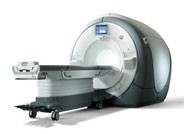
A magnetic resonance (REZ-oh-nans) imaging scan is usually called an MRI. An MRI does not use radiation (X-rays) and is a noninvasive medical test or examination. The MRI machine uses a large magnet and a computer to take pictures of the inside of your body. Each picture or "slice" shows only a few layers of body tissue at a time. The pictures can then be examined on a computer monitor. Pictures taken this way may help caregivers find and see problems in your body more easily. The scan usually takes between 15 to 90 minutes. Including the scan, the total examination time usually takes between 1.5 to 3 hours.

What are the different types of MRI examinations?
An MRI can be used to evaluate brain, neck, and spinal cord problems. It can also help caregivers look at problems with your chest, heart, abdomen, joints, or blood vessels. The following list includes some common magnetic resonance imaging examinations.
For more information, visit:
- RadiologyInfo - How Should I Prepare?
"The radiology information resource for patients"- Magnetic Resonance (MR)— Angiography (also called Angiogram MR; Angiography MR; or MRA)
- Magnetic Resonance Imaging (MRI)— Body (also called Body MR)
- Magnetic Resonance Imaging (MRI)— Breast (also called Breast MRI)
- Magnetic Resonance (MR)— Guided Breast Biopsy (also called Biopsy-Breast, MR-Guided; Breast Biopsy, MR-Guided; MR-Guided Breast Biopsy; or Needle Biopsy of the Breast, MR-Guided)
- Magnetic Resonance Imaging (MRI)— Cardiac (Heart) (also called Cardiac MRI or Heart (Cardiac) MRI)
- Magnetic Resonance Imaging (MRI)— Chest (also called Chest MRI)
- Magnetic Resonance Imaging (MRI)— Head (also called Head MR)
- Magnetic Resonance Imaging (MRI)— Musculoskeletal (also called Musculoskeletal MR)
- Magnetic Resonance Imaging (MRI)— Prostate (also called Prostate MRI)
- Magnetic Resonance Imaging (MRI)— Spine (also called Spine MRI)
- Magnetic Resonance, Functional (fMRI)— Brain (also called Brain Imaging, fMRI; or Functional MRI (fMRI)—Brain)


How Should I Prepare?
CLAUSTROPHOBIA:
If you require medication for claustrophobia, please have your referring physician arrange a prescription for you.
CREATININE BLOOD TEST:
This is required within 30 days prior to the MRI examination for the following people:
- Patients who are age 70 years or older;
- Patients who are diabetic (insulin and non-insulin dependent types);
- Patients who have a history of renal insufficiency/renal masses/single kidney.
If you have this test done at an outside facility, it is your responsibility to obtain a copy of the result and bring it to the appointment with you.
EATING:
If you are getting intravenous contrast material, which helps your body part show up better in the MRI pictures, or sedative (SED-ah-tiv) medicine during the examination, you may be asked to not eat solid food for four to eight hours before the examination.
If you are getting a mesenteric ischemia MRI, you may not have food for six hours prior to the examination, but you may have water.
If you are receiving a certain cardiac MRI examination, you may not have food for two hours before the examination and NO coffee (decaf or regular); NO caffeine; NO tea; and NO chocolate for 24 hours prior to the examination.
METAL:
Because they can interfere with the magnetic field of the MRI machine, metal and electronic objects are not allowed in the examination room. Do not wear any jewelry including rings, earrings, necklaces, or watches. Take off any clothing that has metal hooks, buttons, zippers, or other metal items on it and anything metal that is on your body such as the following:
- credit cards and hearing aids, all of which can be damaged;
- pins, hairpins, and similar metallic items, which can distort MRI images;
- removable dental work;
- pens, pocketknives, and eyeglasses.
CARE AGREEMENT:
You have the right to help plan your care. To help with this plan, you must learn about your health condition and how it may be treated. You can then discuss treatment options with your caregivers. Work with them to decide what care may be used to treat you. You always have the right to refuse care.
CHECK IN:
YOU MUST CHECK IN TO REGISTER 30 MINUTES PRIOR TO THE APPOINTMENT TIME IF YOUR APPOINTMENT IS MONDAY–FRIDAY BETWEEN THE HOURS OF 7:00am AND 5:30pm. If your appointment is outside these hours at the Blake Wilbur Clinic, please report directly to the clinic 30 minutes prior to the appointment time.
REGISTRATION DESKS:
- Stanford Medicine Imaging Center, Palo Alto: 451 Sherman Avenue, Front Desk (open 7:00am-5:00pm).
- Stanford Medicine Outpatient Center, Redwood City; 450 Broadway Pavilion B, front Desk (open 7:00am-5:00pm).
- Blake Wilbur Outpatient Clinic Registration: 900 Blake Wilbur Drive, 1st Floor (open 7:00am-5:00pm).
- Stanford Hospital Department of Radiology Registration: First Floor Main Patient Admitting Area (open 7 days a week).
- Stanford Advanced Medicine Center Registration: 875 Blake Wilbur Drive, 1st Floor, Room CC1227 (open 8:00am-3:00pm).
PAPERWORK:
Insurance: Prior insurance authorization may be required by your insurance company for your radiology study. Please confirm that you have insurance approval from your ordering physician. Please bring any insurance information (card and authorization) and examination requisition with you to the appointment.
SUPPORT:
Bring a family member or friend with you if you need to wait for examination results. They can talk with you and be there to support you during and after the examination. They can also drive you home if you have sedative medicine during the examination. If you do take sedative medication, you cannot drive yourself.
WAITING ROOM:
Ask your caregiver if you want a family member to remain with you during the examination. Your family may also wait for you in the waiting room until your MRI is done. If your family leaves, ask them for a phone number where they can be reached.
PLEASE CALL (650) 723-6855 IF:
- You cannot make it to your MRI appointment on time.
- The problems for which you are having an MRI get worse.
- You have questions or concerns about having an MRI.
View all Imaging Services