CT Lung Cancer Screening
CT Lung Cancer Screening - Information for Patients & Families (pdf)
Patient Story part 1
Introduction
Patient Story part 2
Lung cancer remains the leading cause of cancer-related deaths in the United States.
In June 2011, the New England Journal of Medicine published results from the National Lung Cancer Screening Trial (NLST) that showed a 20% mortality reduction in a high-risk population who had been screened using low-dose CT as compared to a control group screened using chest radiography. NLST is the first lung cancer screening trial to demonstrate such a mortality benefit.
Patient Story part 3
In October 2011, the National Comprehensive Cancer Network (NCCN) issued guidelines recommending low-dose CT screening for lung cancer.
Stanford Medicine Imaging will be offering this screening test to patients who meet the criteria used either in NLST or recommended in the NCCN guidelines. (See Exam Eligibility section)
Currently, CT screening for lung cancer is not covered by insurance. Eligible patients must be referred by a physician. Active smokers undergoing screening CT should enter a smoking cessation program. Screening is not an alternative to smoking cessation.

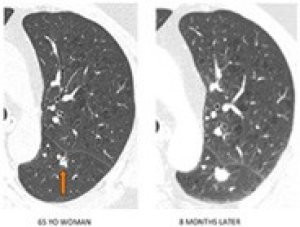
Left: 65 year-old woman
Right: Eight months later
False Positives
Over the period that NLST participants were screened, approximately 40% of individuals had a positive CT result, usually consisting of small indeterminate pulmonary nodules considered suspicious for lung cancer, on at least one of the three annual tests. These findings required diagnostic follow-up, mostly with further imaging, and in some cases invasive procedures such as bronchoscopy or percutaneous biopsy. Of these initial findings, 96.4% were false positives. The rate of complication during follow-up of the CT group was 1.4%. The rate of major complication was 0.06% in the false positive group and 11.2% in those with lung cancer. Of the cancers detected, most were adenocarcinomas, many of which were detected at stage I or II. The death rate from any cause in the CT screening group was reduced by 6.7%, compared to the radiography group. One death from lung cancer was prevented per 320 participants in screening.
Suspicious Nodules
If a suspicious nodule is identified on a screening CT, patients and their referring physician can be provided a list of Stanford physicians with expertise in the further evaluation and management of such nodules – including pulmonologists and thoracic surgeons. The patient may then make an appointment with one of these individuals to determine any appropriate additional steps to be taken.
Lung Nodule Clinic - Lung Cancer
Tel Work (650) 725-7061 Fax (650) 498-6288
http://pulmonary.stanford.edu
Dr. Daya Upadhyay
Division of Thoracic Surgery
(650) 721-2086 or (650) 736-7191
http://thoracicsurgery.stanford.edu
Radiation Dose Reduction and Optimization
At Stanford Medicine Imaging, we understand that radiation exposure is a concern to referring physicians and patients. We are committed to reducing radiation exposure and follow radiation safety principles. CT lung cancer screening will be a low-dose CT exam, with a radiation dose of approximately 1.5 mSv (millisieverts), equivalent to approximately half of the naturally occurring background radiation that a person receives for one year at sea level. This exam does not require intravenous contrast.

CT Lung Cancer Screening is a low-dose CT exam, with a radiation dose of approximately 1.5 mSv (millisieverts), equivalent to approximately half of the naturally occurring background radiation that a person receives for one year at sea level.
What Will Happen during the CT Examination?
The CT scanner is a large machine with a hole, or tunnel, in the center. You will lie on a table that slides into and out of this donut-shaped hole or tunnel. Your caregiver will sit behind a window during the CT scan; however, your caregiver will be able to see, hear, and speak with you at all times. You may be asked to change into a hospital gown and to remove all jewelry, earrings, or other metal objects. Caregivers will help you lie down on the CT scan table. The body part being tested may be kept in place with a cradle or straps to hold it very still. Special lights may be used to make sure that you are properly positioned. You will be asked to hold your breath during the scanning. You must lie very still during the scan. If you move, the CT scan pictures may not be clear.
Exam Eligibility
NLST Guidelines:
- Individuals between the ages of 55 and 74 who are current or former smokers
- History of at least 30 "pack years" of smoking. (A pack year equals the number of packs smoked per day times the number of years the patient smoked; two packs a day for 10 years equals 20 pack years.)
- Former smokers must have quit within the past 15 years
NCCN Guidelines:
- Individuals ≥ 50 years and ≥ 20 pack year
history of smoking and ONE additional risk
factor
- Radon exposure
- Occupational exposure: silica, cadmium, asbestos, arsenic, beryllium, chromium, diesel fumes, and nickel
- Cancer history: lung cancer, lymphomas, cancers of the head and neck, smokingrelated aero digestive cancers such as esophageal cancer
- Family history of lung cancer
- Disease history (COPD – Chronic Obstructive Pulmonary Disease or pulmonary fibrosis)
Exclusion Criteria for Study
- Pneumonia or acute respiratory infection treated with antibiotics in the 12 weeks prior to scheduled low dose CT
- Recent hemoptysis
- Unexplained weight loss of more than 15 lbs in the 12 months prior to screening exam
- CT Scan of Thorax within past 1 year
Exam Preparation
- Please arrive 30 minutes before your scheduled appointment and allow 1 hour for the exam process.
- We request that you obtain a copy (CD or film) of any prior Chest CT scan/s to submit to us on the day of your appointment. Comparison with prior studies allows our radiologists to better assess the significance of any findings present on your screening CT exam.
- We do suggest that you visit our website at http://imaging.stanfordhospital.org
- Exam is currently being performed at Stanford Medicine Outpatient Center, Redwood City (See map)
- CT Lung Cancer Screening is available as a self-pay. You will be contacted by our Patient Access Services Pre-Certification Department or you may also contact them directly at (650) 721-2278 or Patient Financial Services at (800) 794 8978, Monday through Friday 8:00am-4:00pm to request your self-pay discount.
Resources
- http://www.nejm.org/doi/full/10.1056/ NEJMoa1102873
- http://www.cancer.gov/clinicaltrials/noteworthytrials/ nlst
- http://www.nccn.org/index.asp
Patient Financial Services Letter
Thank you for your interest in scheduling a CT Lung Cancer Screening Study at Stanford Hospital & Clinics. This letter is to provide you with important information related to the charges and billing for your services.
Please be advised there is a hospital fee and a separate physician fee associated with this service. If your insurance plan provides coverage, you will be responsible for any remaining balances after insurance pays its portion, including any deductible or coinsurance amounts applied.
There are some insurance plans that do not cover CT Lung Cancer Screening. Therefore, if you receive a notice of non-coverage denial from your insurance plan, a discount off the total charges is available to you upon request. This is subject to change without notice. Please see below the final cost to you with the discount applied:
| CT Lung Cancer Screening | |
|---|---|
| Fee Less Discount | |
| Hospital | $420.00 |
| Physician | $75.00 |
| Total Patient Responsibility | $495.00 |
Should you have these services and your insurance does not provide you with coverage, please
call Customer Service at (800) 794 8978, Monday-Friday 8:00am-4:00pm to request
your discount as outlined above.
To schedule this service, please contact our Radiology Scheduling Center at (650) 723-6855, Monday-Friday 7:30am-6:00pm. We look forward to the opportunity of providing you the best in care and service.
Sincerely,
Patient Financial Services
View all Imaging Services