
Electrocardiogram
Our Approach
Our doctors have in-depth expertise in diagnosing all types of heart problems, no matter how rare or complex. For people with all types of heart conditions, we explore all the possibilities to uncover the underlying causes.
Our world-class technicians, with their advanced skills and training, are what set Stanford apart. Combining our expertise with leading-edge diagnostic tools, our doctors and technicians focus on accuracy as they interpret EKG data, with excellent results. An accurate diagnosis is the first, crucial step to an effective treatment plan.
WHAT WE OFFER YOU FOR EKG
- Nationally recognized expertise, with board certified cardiologists who have specialized training in reading and interpreting your EKG results.
- Precise diagnosis options that combine the latest EKG technologies with the experience and skills of our experienced doctors and care providers.
If you are a new patient and want to request and appointment or need help finding a doctor, please call 650-723-6459, Option 3.
If you are a returning patient, call 650-723-6459, Option 2, to request an appointment.
What Is an Electrocardiogram?
What to Expect
Before
During
After
EKG Tracings
Before the Procedure
Patients may be asked to remove all jewelry from the neck and wrists. Prior to having an EKG, patients should avoid putting on skin cream or oil since it tends to interfere with obtaining a good EKG recording. Men are usually bare-chested during the test. Women are offered a gown. If patients are wearing stockings, they should take them off.
Patients will lie on a bed or table. Small, sticky patches (electrodes) are placed on the chest, wrists and ankles. Areas on arms, legs, and chest where the electrodes will be placed are cleaned and may be shaved to provide a good contact with the skin. The electrodes are connected to a machine that monitors and records the heart’s electrical activity from 12 different views. Patients will be asked to lie quietly while the EKG is recording. The test, which takes approximately 10 minutes, allows the doctor to see patients’ “baseline EKG” and determine if there is any abnormal conduction through the heart while at rest.
- The doctor or the technician will explain the procedure and offer the opportunity to ask any questions about the procedure
- Generally, fasting is not required before the test
- Notify the doctor of all medications (prescribed and over-the-counter) and herbal supplements
- Notify the doctor if patient has a pacemaker
- The area(s) where the electrodes are to be placed may be shaved
- Based upon the patient’s medical condition, the doctor may request other specific preparation
During the Procedure
An EKG may be performed on an outpatient basis or as part of a hospital stay.
Procedures may vary depending on condition and the doctor’s practices.
Generally, an EKG follows this process:
- Patients will be asked to remove any jewelry or other objects that may interfere with the procedure
- Patients will be asked to remove clothing from the waist up. The technician will ensure privacy by covering patient with a sheet or gown and exposing only the necessary skin
- Patients will lie flat on a table or bed for the procedure. It will be important for patients to lie still and not talk during the procedure, so as not to interfere with the tracing
- If patient’s chest, arms, or legs are very hairy, the technician may shave small patches of hair, as needed, so that the electrodes will stick closely to the skin
- Electrodes will be attached to patient’s chest, arms, and legs
- The lead wires will be attached to the skin electrodes
- Once the leads are attached, the technician may key in identifying information about the patient into the machine's computer
- The EKG will be started. It will take only a short time for the tracing to be completed.
- Once the tracing is completed, the technician will disconnect the leads and remove the skin electrodes.
After the Procedure
Patients should be able to resume normal diet and activities, unless the doctor instructs differently. Generally, there is no special care following an EKG.
Notify the doctor if any symptoms you had prior to the test occur. These include chest pain, shortness of breath, dizziness, or fainting.
The doctor may give additional or alternate instructions after the procedure, depending on the patient’s needs.
EKG Tracings
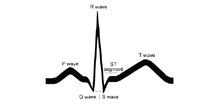
Almost everyone knows what a basic EKG tracing looks like. But what does it mean?
The first short upward notch of the EKG tracing is called the "P wave." The P wave indicates that the atria (the two upper chambers of the heart) are contracting to pump out blood.
The next part of the tracing is a short downward section connected to a tall upward section. This next part is called the "QRS complex." This part indicates that the ventricles (the two lower chambers of the heart) are contracting to pump out blood.
The next short upward segment is called the "ST segment." The ST segment indicates the amount of time from the end of the contraction of the ventricles to the beginning of the rest period before the ventricles begin to contract for the next beat.
The next upward curve is called the "T wave." The T wave indicates the resting period of the ventricles.
When the doctor views an EKG, he/she studies the size and length of each part of the EKG.
Variations in size and length of the different parts of the tracing may be significant.
The tracing for each lead of a 12-lead EKG will look different, but will have the same basic components as described above. Each lead of the 12-lead EKG is "looking" at a specific part of the heart, so variations in a lead may indicate a problem with the part of the heart associated with a particular lead.
Before the Procedure
Patients may be asked to remove all jewelry from the neck and wrists. Prior to having an EKG, patients should avoid putting on skin cream or oil since it tends to interfere with obtaining a good EKG recording. Men are usually bare-chested during the test. Women are offered a gown. If patients are wearing stockings, they should take them off.
Patients will lie on a bed or table. Small, sticky patches (electrodes) are placed on the chest, wrists and ankles. Areas on arms, legs, and chest where the electrodes will be placed are cleaned and may be shaved to provide a good contact with the skin. The electrodes are connected to a machine that monitors and records the heart’s electrical activity from 12 different views. Patients will be asked to lie quietly while the EKG is recording. The test, which takes approximately 10 minutes, allows the doctor to see patients’ “baseline EKG” and determine if there is any abnormal conduction through the heart while at rest.
- The doctor or the technician will explain the procedure and offer the opportunity to ask any questions about the procedure
- Generally, fasting is not required before the test
- Notify the doctor of all medications (prescribed and over-the-counter) and herbal supplements
- Notify the doctor if patient has a pacemaker
- The area(s) where the electrodes are to be placed may be shaved
- Based upon the patient’s medical condition, the doctor may request other specific preparation
close Before
During the Procedure
An EKG may be performed on an outpatient basis or as part of a hospital stay.
Procedures may vary depending on condition and the doctor’s practices.
Generally, an EKG follows this process:
- Patients will be asked to remove any jewelry or other objects that may interfere with the procedure
- Patients will be asked to remove clothing from the waist up. The technician will ensure privacy by covering patient with a sheet or gown and exposing only the necessary skin
- Patients will lie flat on a table or bed for the procedure. It will be important for patients to lie still and not talk during the procedure, so as not to interfere with the tracing
- If patient’s chest, arms, or legs are very hairy, the technician may shave small patches of hair, as needed, so that the electrodes will stick closely to the skin
- Electrodes will be attached to patient’s chest, arms, and legs
- The lead wires will be attached to the skin electrodes
- Once the leads are attached, the technician may key in identifying information about the patient into the machine's computer
- The EKG will be started. It will take only a short time for the tracing to be completed.
- Once the tracing is completed, the technician will disconnect the leads and remove the skin electrodes.
close During
After the Procedure
Patients should be able to resume normal diet and activities, unless the doctor instructs differently. Generally, there is no special care following an EKG.
Notify the doctor if any symptoms you had prior to the test occur. These include chest pain, shortness of breath, dizziness, or fainting.
The doctor may give additional or alternate instructions after the procedure, depending on the patient’s needs.
close After
EKG Tracings
Almost everyone knows what a basic EKG tracing looks like. But what does it mean?
The first short upward notch of the EKG tracing is called the "P wave." The P wave indicates that the atria (the two upper chambers of the heart) are contracting to pump out blood.
The next part of the tracing is a short downward section connected to a tall upward section. This next part is called the "QRS complex." This part indicates that the ventricles (the two lower chambers of the heart) are contracting to pump out blood.
The next short upward segment is called the "ST segment." The ST segment indicates the amount of time from the end of the contraction of the ventricles to the beginning of the rest period before the ventricles begin to contract for the next beat.
The next upward curve is called the "T wave." The T wave indicates the resting period of the ventricles.
When the doctor views an EKG, he/she studies the size and length of each part of the EKG.
Variations in size and length of the different parts of the tracing may be significant.
The tracing for each lead of a 12-lead EKG will look different, but will have the same basic components as described above. Each lead of the 12-lead EKG is "looking" at a specific part of the heart, so variations in a lead may indicate a problem with the part of the heart associated with a particular lead.
close EKG Tracings